
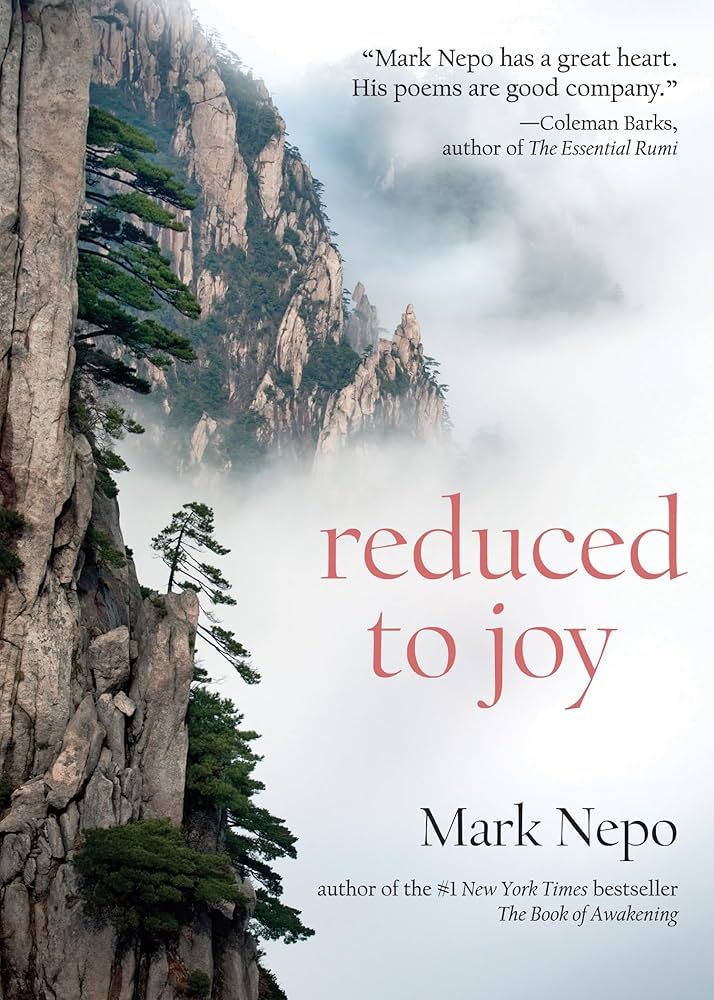
Mark Nepo is good at reflecting on emotions and creating meaningful snippets of memories he’s clearly reflected on. Spirituality, perhaps even a hint of Buddhism, is found sprinkled throughout his book.
As a poet, maybe not so much.
Nepo makes the mistake most SERIOUS contemporary poetry make, which is that they write prose broken up with line breaks that they eyeball on a computer screen, thinking of not why line breaks exist in poetry to begin with, but rather how they can make their prose look like a poem.
Not that there’s anything wrong with this per se. There’s no hard rules in poetry and prose poetry is a thing but if broken prose is going to be considered poetry, I would go further and simply describe the English language as genuinely being poetic in all of its iambic expressions.
Yes, all languages have their natural cadences, and can be read as a song to some extent. Further to the point, not all poetry has to rhyme and most contemporary poetry doesn’t, to the point the very act is forbidden in poetry workshops and university courses.
To say I enjoyed Mark Nepo’s Reduced to Joy, a book of poetry published in 2013, isn’t a compliment meant to be take lightly. He is good at conveying emotion and describing his reflections.
But there comes a point where any one seriously interested in poetry as an art form or craft has to ask questions about discipline and consistency of form, a characteristic of study that Nepo seems to either reject or not have mastered at all.
Enjambment, while it can have its uses when employed selectively, is often an excuse for sloppiness, laziness, or as a way to supposedly create tension in broken prose as if the wording of the arbitrary line breaks are meant to be spoken dramatically. But if we’re being honest, this excuse for not practicing any control is stupid. Yes, there are poets like Charles Bukowski who used the practice of broken prose to create a sense of sloppiness or carelessness, but if that’s the case, Bukowski’s whole output as a writer was meant to be characterized by his figure as a drunkard and loose man, revolting against the conventional standards of his time. His sloppiness is his authenticity.
In Nepo’s case, he is merely doing what everyone else is told to do, and while I would argue he is better than most at what he does, there comes a point where the rejection of form becomes the necessitation of form to begin with.
It’s a snake that eats its own tail, an argument that gets eye rolls out of current poetry professors, and applause from actual aspiring poets with skill.
If sloppiness is the brush strokes Mark Nepo is trying to employ, much like a painter carelessly letting their emotions take over their abstract paintings, then so be it.
But I think the time has come for a return to form and justification of unwieldy enjambment if that is the case. If Mark Nepo is trying to argue that his emotionally charged poems are meant to be whip-like brush strokes of a painting then I would argue he is merely a prose writer afraid to write paragraphs that employ poetic use of cadences naturally occurring in the English language.
Iambic pentameter is a thing and Shakespeare often made poetic what was usually just pretty prose in his characters’ dialogue often utilized in his famous stageplays.
Mark Nepo, on the other hand, is a good poet and Reduced to Joy is filled with wonderful poetry. But in 2025, his style has become the very trope defining definition of a cliché.
Bring me back the classics and return to form. A little bit of discipline never hurt anyone.
 The Verse Universe