
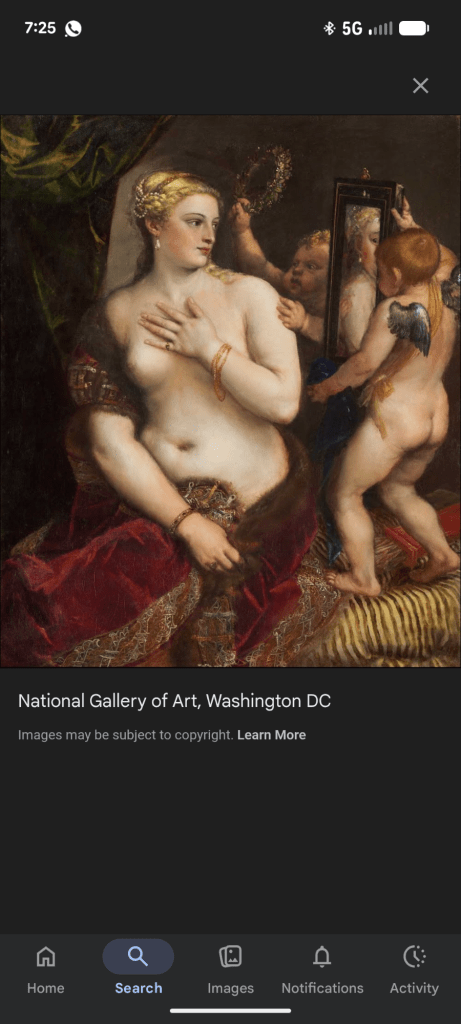
Venus gazes into a mirror held by cherubs–angels so childish they merely are to many the angelic representation of aborted babies who never had a parent to develop their own immature desire to please parents who simply acknowledge their existence.
The painting is introduced with a pitch in an English copy of the novella Venus in Furs, in which the unidentified narrator mentions the painting’s true title, located in Dresden Gallery. The ability of an author to provide such a contemporary detail in a book first published in 1870, quite possibly the first entry in contemporary fiction as far as my own knowledge goes.
The painting depicts a woman the audience is led to assume is Venus gazing longingly in a mirror held by a more mature cherub, as the obvious becomes more obvious: our model is cold in her acknowledgment of her self, perhaps a reflection of how deities deigning for God’s simply do not have the patience to deal with slaves who simply cannot acknowledge the importance of emotion in a woman’s romance, sadly a reflection of how German men feel superior in their own fantasies even author Isaac Asimov could not escape.
Coldness runs a homosexual the wrong way, their greed often displayed in their anger of having a suitor deny their advances. Our model Venus obscures her left breast with her left arm, shaking off a pinky ring that signals her Hinduistic appreciation, her left hand centered in the middle.kf her chest, signifying she is centered in her self.
An astute observed will note her deceit with he resting right hand that holds a lavender blanket above her own loin, again hiding her love as she retains her guarded centeredness. On her ring finger is a butterfly ring that signifies a marriage to a suitor whom the audience is most likely ignorant of, myself included.
The implication of such an elementary painting presented to educate the importance of meis en scene in literature is enjoyable to describe, but if we are to appreciate such a work of art, it is important to remind our audience that to fully appreciate a painting or even sculpture, we should witness such a work in person, where there the texture of the paint is available to be gazed upon, perhaps suggesting this digital copy is insufficient to fully appreciate the romance of men and women in search of something more fulfilling that a crude and misunderstood euphemism…
 The Verse Universe