
What is this?

Poetry Analysis
If every musician wants to be a composer,.then it is quite clear every singer had that one love that made them who they are.
Goo Goo Dolls is not a band I relate to as a member of a generation I feel more like a younger brother too than actually representative. I don’t find the millennial label restricted by a number or year, but xellenials is a form of metrosexuality that I once found purposeful but increasingly bland as I aged. Reinforced by the very definition of what xellenials are.
I don’t think this woman the lead singer is calling, but I would like to understand why she means so much to him…
Thanks for checking out this blog post. I want to apologize to my poetry enthusiasts for being gone for so long!
During the last two months, I have been at easy work finishing my first novella, entitled Dance in the Dark. The book is 70 pages and was a little time consuming, taking over ten years for my heart to finally give birth to an independently published book through Kindle Digital Publishing (KDP) on Amazon.
While the book has remained the same in Genesis since it was first conceptualized and outlined all the way back in 2014, it took a lot of ghosts who I cannot list all here to help bring this product to fruition.
The plot follows a psychology researcher at The Ohio State University who has invented a device called the Empathy Machine, that allows the wearer to see the daydreams of other people.
The book itself has some rough edges, and is in dire requirement of an accomplished editor to give it a thorough scrubbing. However, as an author, it was important to honor the origins of publications and make sure the premiere effort remained small and out of the hands of publishing houses who refuse to print novellas.
Amazon has its own setbacks, but every flower starts with a seed and dirt, and hopefully some rain and eventually sunshine to allow it to grow.
The book can be purchased here: https://a.co/d/7PAmzYl
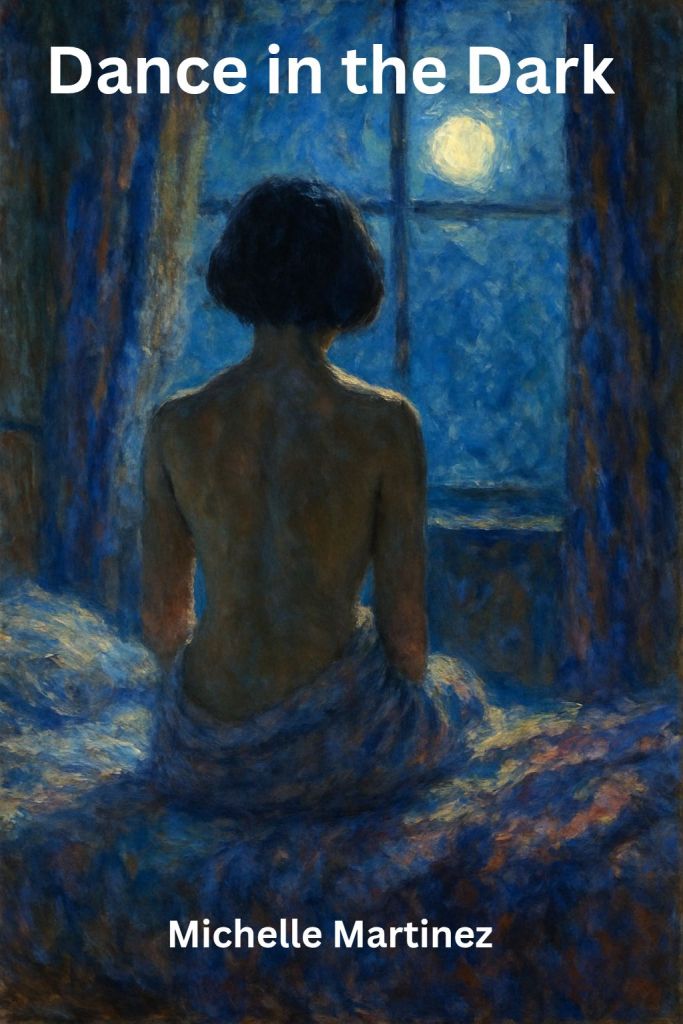
Reviews are always welcome, but not required. Alas, now that this novella is finished in its early form, my heart longs for a break and hopefully future poetry analysis. I am trying to secure an interview with poets Dan Schneider and perhaps his wife Jessica Schneider, but also have purchased some great thrift store finds to review and poems to analyze.
I do write for a living, though the income is pitiful, and I have a new play in the world entitled Aerith and Darcy: A Faerie Tale in 5-Acts. That work will have time to cook, however, and as I take a vacation from my author’s duties, hope to read more of my readers’ poetry.
Thanks for taking the time to read this brief interruption!
Michael, Aka, Michelle Martinez
A headache sucks, cognitive dissonance is even harder for someone who is discovering worlds as they fall from heaven’s own divine bells. An analysis of the poem ‘I Felt a Funeral in my Brain’ by Emily Dickinson is easy to perform because of how observant and easy to grasp it is in its use of metaphorical descriptions of a migraine.
Emily had a sense of humor most seem to ignore in her writing. She was also passionate and romantic, probably in love with a female friend for a while, and to some highly erotic in what she did not make explicit more than what she actually did.
She also played with children’s rhymes and nursery tales, and was an aunt and a failed mother who wanted a child if only she could find a husband worth falling for. But turning away from Victorian anger and patriarchal structures became this poet’s bane and gift. She simply avoided the unpleasantries of civilized courtship, in favor of rest and seances by herself in bed. She was a spirit channeler and ghost writer in the most literal definitions of those words.
But feeling a funeral in her brain must have been an inside joke for an author like Mary Shelly, whose own studies of human biology must have struck the prudes of their time as both horrific and grotesque. But that is a funny observation to begin a rhyme with. If she felt a funeral in her brain, who exactly was the deceased, and why did hearing the bells of paradise cause her to fall so much?
Funerals are long and dry, filled with family and friends, and usually sorrowful. What exactly caused Miss Dickinson to feel this way? Was the joke about an affair, feeling an orgasm as euphemisms by their little death suggest, and that falling off with the burial ceremonies? And did falling from grace, as the divine bells must have woke her up, remind her of how many worlds there were to explore?
Dickinson lifts her words and imagery from John Donne and his famous line, “whom do the bells toll for? / they toll for thee…” But her experience of death must have been broken by her waking to the possibility that there are so many suitors to encounter, and so many lives to lead. Perhaps she was becoming aware of just how popular her verses were getting, attracting the attention of onlookers and admirers bespectacled by her reclusiveness. She was plain in appearance, and small, a little too broad for some, and a little too performative for others.
I would have fallen in love with her words and been smitten by her average appearance. She would appreciate the sentiment, but alas, unless the day of resurrection comes sooner, we are not destined to meet physically in this reality. How those words fall like broken planks, we taking the plunge into despair and suicide, knowing we can see these worlds, and yet must wait to live in them. That must have been some funeral, indeed…
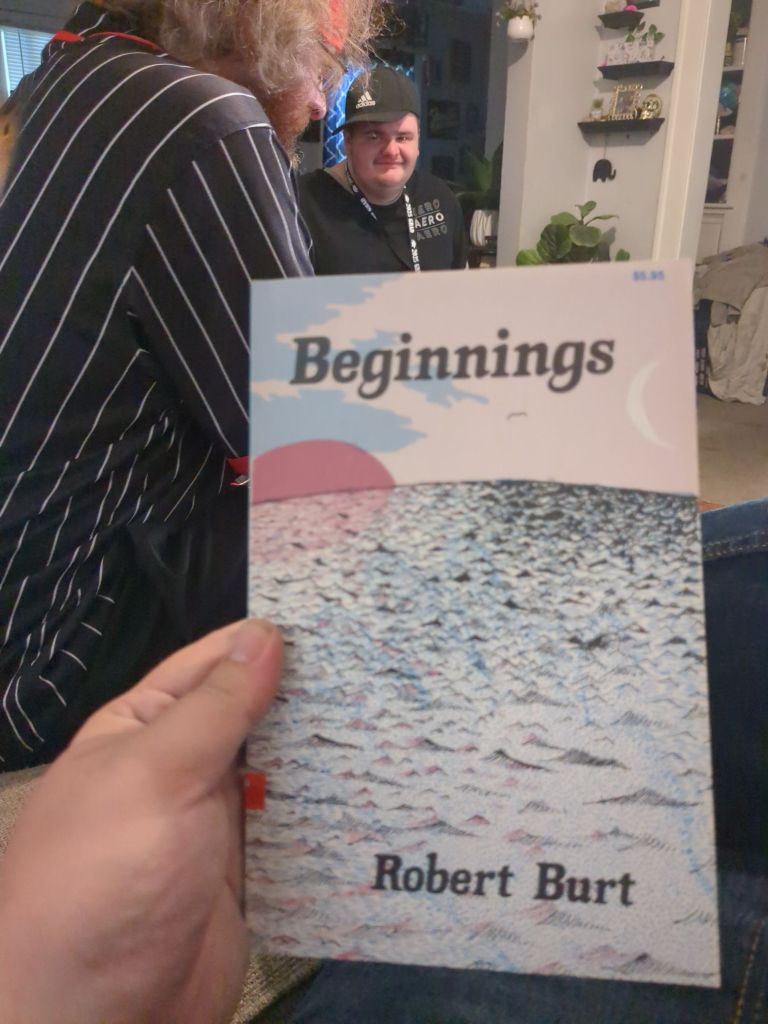
A Canadian poet, I discovered this spiritual looking chapbook of poetry at the Goodwill in Bedford, Michigan. The question is who is Robert Burt and why is he so obsessed with seagulls?

I’m not sure if I actually enjoy Burt’s more pastiche style, but it is refreshing to read a contemporary poet who likes to use some semblance of musicality in his poetry. Some of them even have stanzas! It really is the small things that please me. He even has similes! A contemporary poet that also reads other people’s poetry?

I do enjoy this poet’s eye for details and small observations. Like a more sophisticated Jack London, if London had actually written verse, there is something awe inspiring in Burt’s reflections on the Canadian wilderness. I would not say he is so much profound as he is poignant.
Burt also seems to be a less metaphysical poet and more of an Ansel Adams style photographer of the beauty and wonder of nature. He might have been an interesting guy, but regretfully he passed away in 2022.

As you can see, Burt, while not the most talented Bard on the Northside of the North American Continent, does pay respect to the history of what truly is a beautiful language when employed with thought and a sense of lyricism. He does not imitate Bukowski and other enjambment heavy poets such as Sharon Olds, nor rely on prose to convey what can be said succinctly with actual lines that make sense!
It’s just too bad there is no wikipedia page for this poet. Nor information of how his second chapbook ended up at the local thrift store in Michigan.
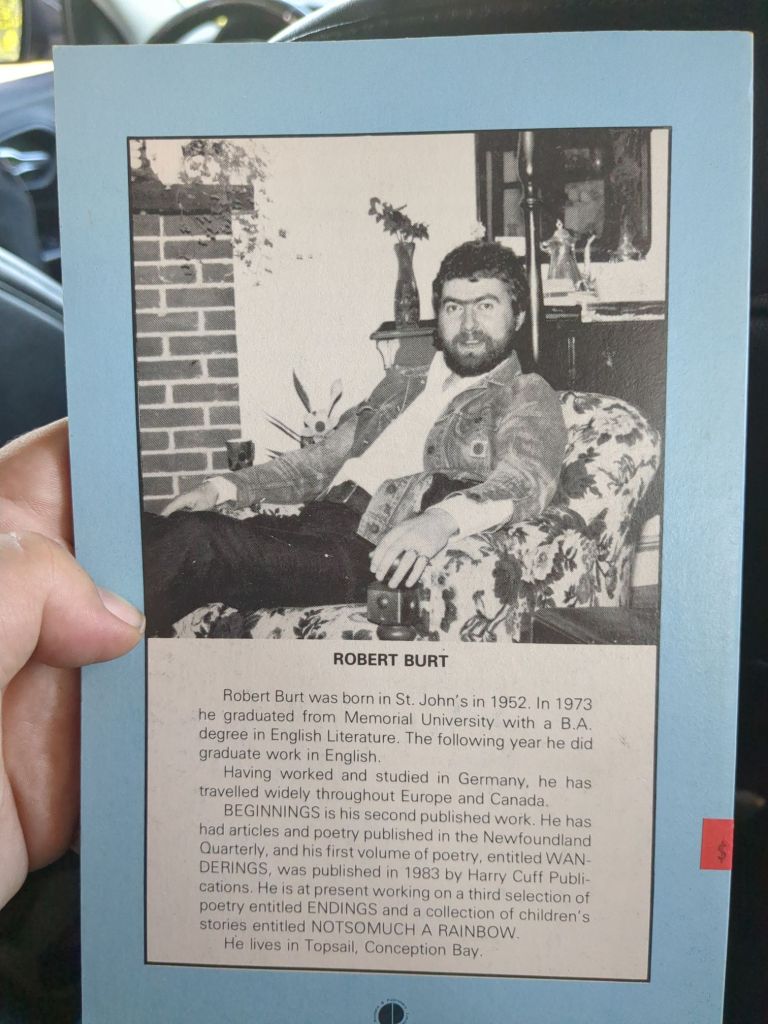
I would honestly call his style of verse ‘yacht’ poetry, after the yacht rock vibes of bands like Toto and Vampire Weekend. His words are calming, playful, humorous. He enjoys the field and does not offer pretense in the way of bland run-on sentences as SO MANY OTHER contemporary poets do. You won’t find his works reviewed on Goodreads nor Amazon, but this poet did exist. That is something to cherish.

Presented as more of a series of prayers and devotionals, this slender hardback book of poetry by Helen Steiner Rice, entitled Daily Stepping Stones, is an impressive collection of religious fluff. I say that lovingly, mind you, as fluff is like cotton candy, and while sweet and simplistic in design, can often bring joy and delight, and even make our stomachs feel full.
Rice’s poetry is more classical in structure, featuring conventional end rhymes and sing-song style meters that have long since gone out of style, and yet have never really gone away either.
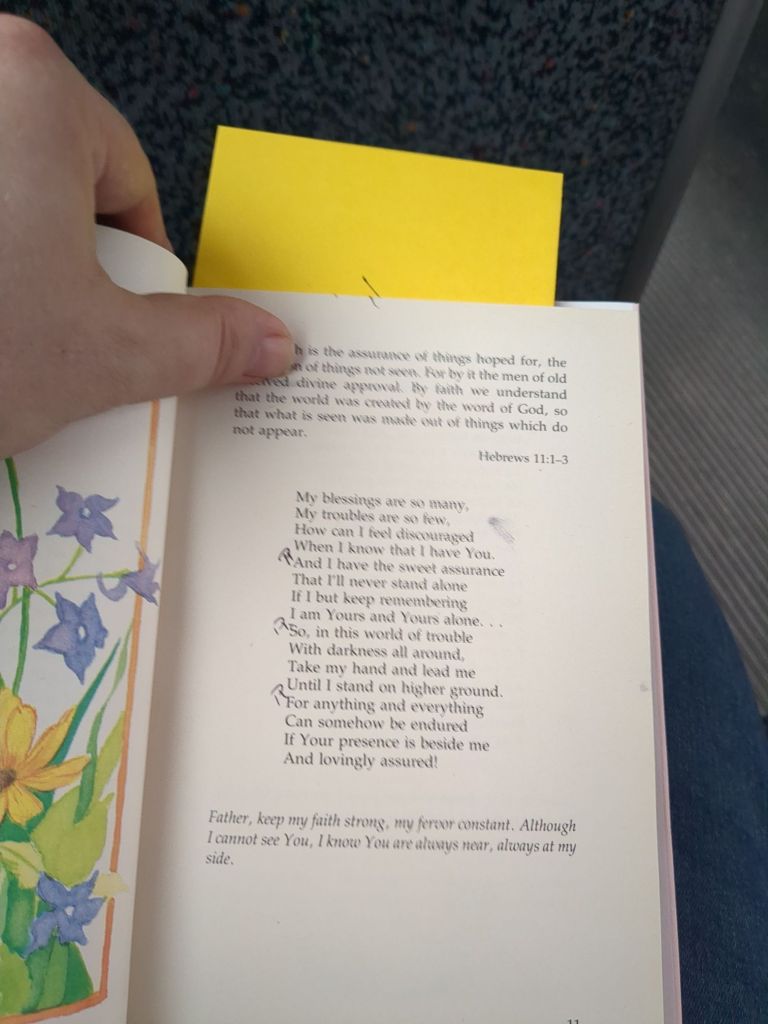
Being fluff, it is easy to review this book on a website or app, such as something like Goodreads, but more difficult in trying to think of something meaningful to impart from it. One would notice some small proofreads I made in the book, as such with the above example, and notice that Rice’s poetry could use some basic edits and proofreads. For example, the untitled poem photographed would work better if broken up into stanzas of four lines each.
Rice’s poetry could also use basic English grammar standards to help dictate how she wants her poetry to be read aloud, if it is intended to be read aloud. A hefty amount of reading William Butler Yeats’s poetry would have served the poet well.

Alas, these mistakes are typical of self-published Christian poetry, usually excused by feigned humility and lack of pretense. Mild annoyances aside, Rice’s poetry is simple and clean, and if we are allowed to say this anymore, technically proficient in its construct. While many will deride such poetical fluff, there is also much to take from her work. Perhaps humility and lack of pretense isn’t so bad afterall?

There’s a certain privilege white authors held in the history of English publications. Usually born to a certain social stature and enabled by education and familial ties to publishers, it’s often hard to fathom the disgrace at seeing how devoted a writer could be to format and pretense but of so little substance.
This excerpt of the poem ‘Cadenus to Vanessa’s by author Jonathan Swift is clearly formatted with iambic tetrameter lines, a stress and unstressed cadence of 8 syllables per line, with rhyming couplets as its poetic structure. The poem is very pretty but doesn’t say much in ways of observation more than a plea for a woman to be chaste with the male narrator, asking that she should “keep a worthy lover’s heart”, an almost pathetic attempt of trying to convince the woman to not break up with him.
The excerpt photographed above is from a collection of Irish Love Poems edited by A. Norman Jeffares, a paperback and slim copy I purchased from a nearby Salvation Army for a mere 99 cents.
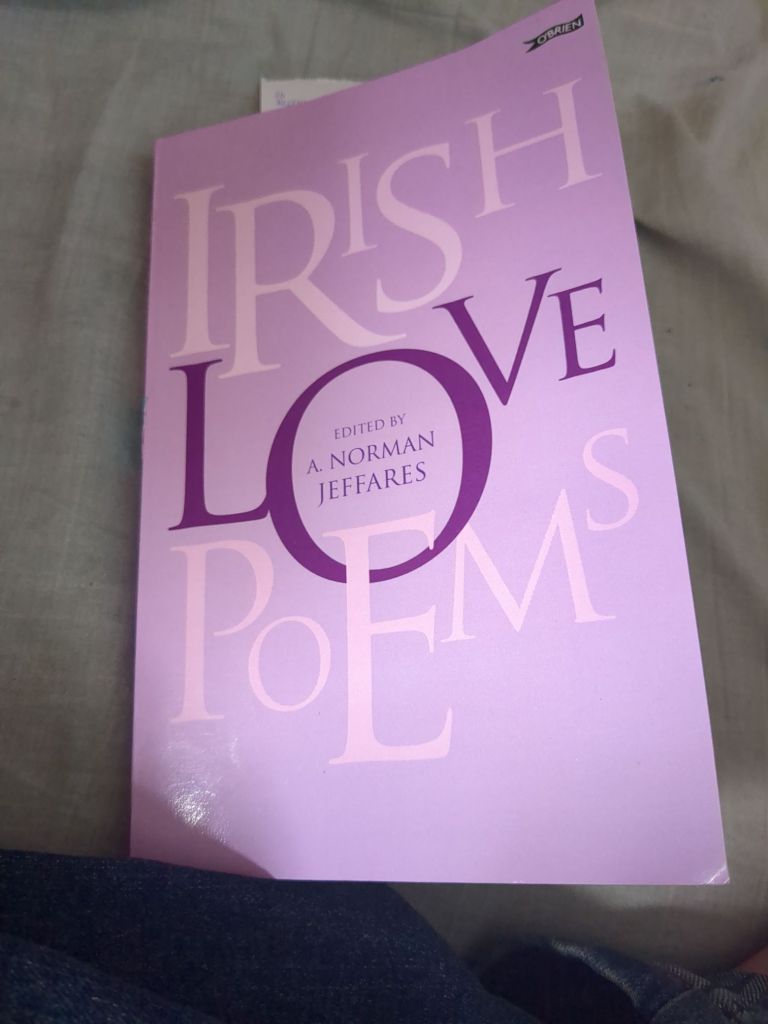
The lines quoted are somewhat disappointing as a poem, though obviously very pleasing in construct and clear presentation. That is the benefit of analyzing older poetry, in that structures and discipline of form was more common, even in the more experimental works. But there’s something rather bland in Swift’s poem, featuring an autobiographical basis. The poem was written about a fellow writer named Esther van Homrigh, a woman I don’t happen to be particularly familiar with, nor Johnathan Swift himself for that matter. But the heroine does have her own poem recollected in this sparse book, a poem entitled ‘Hail, Blushing Goddess, Beauteous Spring’.

Again, these Irish poems are very pretty and even delicate, worthy of all the praise and adoration they have received through their histories. It’s clear the couple held affection for each other very much, though the poems themselves do not state the reason for why the romance ended in failure.
But sidestepping the story behind this affair, there is something to cherish in the simplistic elegance of both authors’ verse. The two clearly understand the forms they are sculpting their emotions out of, even if Swift’s poem is more pathetic in its plea for devotion, whereas van Homrigh’s seems more observant and astute, understanding how the narrator’s tuneful words draw her into his seduction.
But alas, musicality and pretty minces of affection are not enough to sway a woman’s heart, an observation most young men learn all too well in time. There’s an air of dishonesty in Swift’s proclamation for his Vanessa to ignore his vices and find fault in herself, or, him, but to remain true despite these faults. Like our protagonist and narrator David Copperfield from the much overpraised and dishonest novel by Charles Dickens, it’s this lack of personal accountability that is passive aggressively passed onto the female attractions in each dishonest narrator’s corresponding life. Rather than explore the vices in this excerpt, the conceit is to remain faithful and not give up on him, unless he would be a “blockhead”, or stupid person, and a “rake”, or wealthy person.
The crude line is rather unpoetic and yet humorous, like the blasts of a trumpet to wake up a bored band audience, but again ignoring the reason that must undoubtedly lie in our narrator’s own behavior. We are all responsible for our actions and events that unfold in our personal affairs, whether because of prayers or personal accountability issues.
Like a loser going down in battle for Vanessa’s heart, our Cadenus seems to suggest that only “wit and virtue” grows in its place; But let me tell everyone a secret about romance: a woman can handle criticism and usually prefers it to feint and pretty praise, a lesson Swift hopefully learned from his own very doomed affair. It’s a lesson most men should learn, and hopefully not abuse too much.


A small poem by author Maya Angelou. More endearing and simplistic in its expression than actual intellectual stimulation, the charm in Angelou’s words lie more in the poem’s simplicity and earnestness in expression. An inspiration in clean lines and clutter-free verse that every poet could take a note from…

I was in a bad mood last night reading vaguely depressing prosaics by supposed poet Madisen Kuhn. I fell asleep disappointed, and woke up hung over from a feeling of unease. Waking up, I tried to dive into a novel called Paprika by author Yasutaka Tsutsui but found myself too distracted: I needed something to get my mind off how irritable Kuhn’s book Almost Home made me feel, which is when it hit me to read something I actually liked. I found this copy of the Portable Henry Rollins at my local library, and I have to say, his anger resonates with me.
Rollins writes what is known as ‘destruction poetry’, long forms of verse that are unapologetic in their ramblings of anger and hate, begging for power structures to be dismantled and attractive women who use their looks to get sales and positive reviews to be raped in criticism. It’s a dark territory that only a heavy metal artist can tap into, and while I try not to go there too often in my own reserved writing, do find refreshing and even necessary to a certain extent.
Rollins is not the greatest poet or writer by any imagination. He writes long free form, often with one word lines and poor word choice. Accuracy is not his strong suit, at least not in his earlier works, but he does have anger and a better sense of how to make his limited writing skills leave a punch in your gut. His work was just the emotional palette cleanser I needed for a woman like Kuhn whose writing is too timid to explore the darkness of humanity’s often tortured existence.

Take this excerpt for example. Rollins falls into the habits of writing one word lines, but unlike other writers, actually makes the words count and leave a devastating impact on the reader. These are words that actually resonate: “cracked / crumbling / rumbling soul / shattered”… This is a beginner’s poem and style, but there is actual chicken on the bone, an anger of being discharged by a lover that showcases his hurt without even delving into too many specifics. The poem even has a sonnet-like early conceit in being nothing more than flicked ashes from a cigarette, an overdone and yet profound metaphor that hits home how burnt our narrator actually feels.
That is the poetry we crave. Yes, authors like Madisen Kuhn or Rupi Kaur can convey their emotions, which is great, but it is writers like the metal singer Rollins who make us feel those emotions. Like a sculptor working with a large stone, there’s material to chisel, hurt to feel, anger to express. He cares deeply about his words, and even his portrait on the front cover conveys his insecurities as a writer. He is not without criticism, and could use his own very necessary discipline in form, but if one is going to write long rambles or diarrhea of prose, then authors like Rollins or say the always omniscient Charles Bukowski, even in their own limited style, can truly bring out the emotional anger that is necessary to truly sculpt an image out of.
Yes, an image! Poetry is visual, like a painter trying to capture a still life, and metaphors and conceits are crucial to giving us a picture of what these authors are trying to envision.

Like I said, Rollins is not the greatest poet alive. But like, for instance, say fellow poet Fariha Róisín, he knows how to bitch and rant, and really put some putzpah in his sauce or dough. He’ll roll you a meat pie or sourdough, but he’ll also spit in the fermenting ground wheat and flour when you’re not looking.
Not that anyone wants to eat his spit, but Christ, at least there’s spit for you to digest!
Regretfully, this collection is only a sample of Rollins writing and the only book of his that I could find at my library. I’m low on funds this month after purchasing some art supplies to purchase anymore of his works, but will make an effort hopefully in August to buy an actual completed work by him. For now this sample will have to do, but thank God I can feel better knowing I have an actual poet to look forward to reading.

 The Verse Universe